
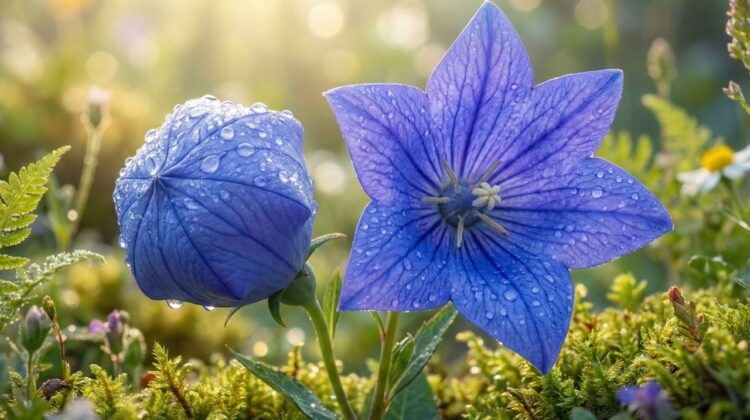
There are very few plants in the garden that invite you to play with them. The Balloon Flower is the delightful exception.
If you have ever stood in front of a Platycodon grandiflorus, you know the temptation. The buds swell up like perfect, air-filled origami balloons. And if you gently squeeze the sides… pop! They burst open into stunning star-shaped petals.
It is this playful nature that makes the Balloon Flower a favorite for children and “young at heart” gardeners. But here at Morflora, we know that playfulness often hides profound wisdom. Beyond the fun, this flower carries a deep, ancient aura rooted in East Asian culture, symbolizing Honesty and Unchanging Love.
Let’s explore why this “popping” beauty deserves a permanent spot in your garden and your heart.
The Botanical Identity: The One and Only
The Balloon Flower is special because it is a “monotypic” genus. That means there is only one species in the entire genus Platycodon: the Platycodon grandiflorus. It doesn’t have a confusing family tree; it stands alone.
Native to East Asia (China, Japan, Korea, and Siberia), it is a hardy perennial that belongs to the Bellflower family (Campanulaceae). While we love it for its blue, pink, or white flowers, in its homeland, it is equally treasured for what lies beneath the soil: its thick, ginseng-like taproot.
The Aura: Symbolism of Honesty and Connection
In the language of flowers, the Balloon Flower has a very specific and noble set of meanings.
1. Honesty and Obedience
Perhaps because the flower opens itself up so completely (from a sealed balloon to a wide-open star), it symbolizes Honesty. It hides nothing. In some traditions, it also represents Obedience—not in a submissive way, but in the sense of following one’s true path or destiny without resistance.
2. Unchanging Love (The Return)
Because the plant is a long-lived perennial that comes back faithfully every summer, it symbolizes Unchanging Love. It is the perfect flower to represent a relationship that has stood the test of time, enduring the cold winters only to bloom again, vibrant as ever.
3. The “Five Blessings”
The flower has five petals fused at the base. In numerology and symbolism, the number five is often associated with balance and the human experience (five senses). The star shape represents guidance and protection.
The Cultural Soul: The Legend of Doraji
To truly understand the soul of this flower, we must look to Korea, where it is known as Doraji.
There is a famous Korean folk song called “Doraji Taryeong” that celebrates the beauty of finding these flowers (roots) on a mountain. But the folklore goes deeper.
The Legend of the Waiting Maiden:
Legend tells of a young maiden named Doraji who waited for her lover to return from a long journey. She waited for years, eventually turning into a flower on the mountain slopes. The “balloon” shape represents her heart, full of waiting and hope, which eventually bursts open with love. This connection makes the flower a poignant symbol of longing and reunion.
Note for Foodies:
In Korea, the root is not just a legend; it’s a side dish! Known as Doraji-namul, the roots are seasoned and eaten for their health benefits. It is a flower that feeds both the soul and the body.
The Style Guide: A “Pop” of Blue in the Garden
As Shiny Aura, I adore plants that bring “True Blue” into the garden because blue is a rare color in nature. Here is how to style Platycodon for maximum impact.
1. The Sensory Garden (For Kids and Peace)
Because of its tactile nature (the popping buds), this is a must-have for a Children’s Garden or a Sensory Garden.
- The Look: Plant a border of dwarf Balloon Flowers (like the ‘Sentimental Blue’ variety) along a pathway where little hands can reach them.
- Why it works: It encourages interaction with nature. Just teach the kids to be gentle—only pop the ones that are ready to open!
2. The “Moonlight” Cottage Border
Blue and white flowers glow beautifully at twilight.
- The Look: Mix Blue Balloon Flowers with White Shasta Daisies and Silver Lamb’s Ear.
- Why it works: The intense violet-blue of the Balloon Flower contrasts sharply with the white and silver, creating a cooling, calming visual effect. It’s perfect for a “Moon Garden” intended for evening relaxation.
3. The Container Star
If you don’t have a yard, Balloon Flowers love pots.
- The Look: Use a White Ceramic Pot to make the blue blooms really stand out.
- Why it works: Their upright habit means they don’t flop over easily. They look neat, tidy, and architectural on a balcony or patio.
Care Tips: The Art of Patience
Balloon Flowers teach us patience, especially in the spring.
- The Late Sleeper: This plant is notorious for waking up late. In spring, when your tulips are up, the Balloon Flower is still asleep underground. Do not dig up the spot! Mark it with a stick so you don’t accidentally dig into the dormant roots.
- Sun Lover: They crave full sun (at least 6 hours) to produce the most balloons. In shade, they get leggy and flop over.
- Deep Roots: Remember that thick taproot? It makes the plant very drought-tolerant once established, but it also means it hates being moved. Pick a spot and stick to it. Unlike perennials you divide often, the Balloon Flower prefers to be left alone to grow deep.
- Deadheading: If you pluck off the faded flowers (a sticky but satisfying job), you can trick the plant into blooming well into autumn.
Final Thoughts
The Balloon Flower is a reminder that it is okay to take your time. It’s okay to sleep in late in the spring. It’s okay to keep your heart guarded in a “balloon” until you feel safe enough to pop open into a star.
Whether you plant it for the playful joy of popping the buds, or for the deep symbol of unchanging love, the Balloon Flower brings a unique, honest energy to any garden.
So, are you ready to add a little “pop” to your life?