
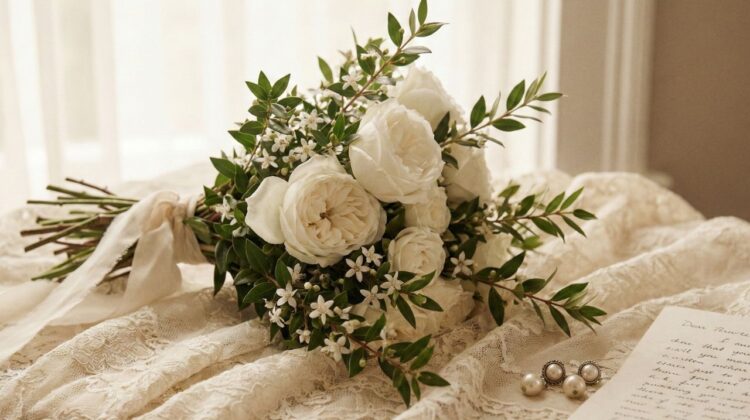
Some flowers are trendy, flashing in and out of style like fashion seasons. Others, like the Myrtle, are timeless. For thousands of years, this modest evergreen shrub with its starry white flowers has held a sacred place in the history of human romance.
If you have ever watched a British Royal Wedding, you have seen Myrtle. Whether it was Queen Elizabeth II, Princess Diana, or Kate Middleton—every royal bride carries a sprig of Myrtle in her bouquet. But why?
As Shiny Aura, I love plants that carry a legacy. The Myrtle (Myrtus communis) isn’t just a pretty filler green; it is the ultimate botanical blessing for a marriage. It represents love that doesn’t wither, just like its evergreen leaves. Let’s uncover the secrets of this ancient symbol of devotion.
The Botanical Identity: The Star of the Mediterranean
Native to the Mediterranean and North Africa, the Common Myrtle is an evergreen shrub that releases a fresh, herbal fragrance when its leaves are crushed. In summer, it blooms with delicate, fluffy white flowers that look like tiny exploding stars, followed by blue-black berries.
It is not a showy plant. It is humble, sturdy, and aromatic—qualities that ancients believed a good marriage should possess.
The Goddess Connection: Aphrodite’s Sacred Plant
Long before it reached Buckingham Palace, Myrtle belonged to the gods. In Ancient Greece, the plant was sacred to Aphrodite, the Goddess of Love and Beauty. In Rome, it was dedicated to her counterpart, Venus.
Legend says that when Aphrodite rose from the sea foam, she hid her nakedness behind a Myrtle bush. Because of this, the plant became the supreme symbol of feminine grace, beauty, and love. Temples were surrounded by Myrtle groves, and wreaths of its leaves were worn by brides to ensure a fertile and happy union.
The Aura: Symbolism of Love and Prosperity
Beyond mythology, the Myrtle carries specific meanings in the Language of Flowers that are still relevant today:
1. Love and Marriage
This is its primary meaning. However, unlike the red rose which signifies passionate, burning love, Myrtle signifies fidelity and domestic happiness. It is the kind of love that settles down and builds a home.
2. Prosperity and Good Luck
In Jewish tradition, Myrtle branches represent success and are used during the holiday of Sukkot. Having a Myrtle plant growing near your house is often considered a charm for prosperity and good fortune in business.
3. Restoration and Recovery
Because the plant is incredibly resilient and can regrow even after being cut back or burned, it also symbolizes recovery and survival. It is a beautiful gift for someone recovering from an illness.
The Royal Tradition: A Victorian Legacy
The modern obsession with Myrtle in weddings started with Queen Victoria. In 1845, her grandmother-in-law gave her a posy of Myrtle. Victoria planted a sprig from that nosegay in her garden at Osborne House on the Isle of Wight.
That bush flourished, and ever since, a sprig cut from that exact bush has been included in the wedding bouquet of every British royal bride, including Queen Elizabeth II and the Duchess of Cambridge (Kate Middleton). It is a touching tradition that physically connects generations of women.
Biblical Meaning of Myrtle
Myrtle also appears frequently in the Bible. In the book of Isaiah, it is written: “Instead of the thornbush will grow the juniper, and instead of briers the myrtle will grow.”
Here, the Myrtle represents divine generosity, peace, and God’s blessing replacing the “thorns” of life. It is seen as a sign of life returning to a barren land.
Styling and Uses: More Than Just History
You don’t need to be a princess to enjoy Myrtle. Here is how to use it in your modern life:
- The Wedding Bouquet: If you are getting married, tuck a few sprigs of Myrtle into your flowers. It adds texture, scent, and a hidden layer of meaning about fidelity.
- Home Decor: Dried Myrtle keeps its scent for a long time. Use the branches in potpourri or hang a wreath of dried Myrtle on your door to invite positive energy.
- Topiary Art: Because it has small leaves and grows densely, Myrtle is excellent for shaping into topiaries (balls, cones, or pyramids). A pair of Myrtle topiaries in terracotta pots looks stunning flanking a front door.
Care Tips: Growing Your Own Luck
If you want to plant your own “Royal Bush,” here is what you need to know:
- Sunlight: It loves the sun. Give it a warm, sheltered spot, preferably against a south-facing wall if you live in a cooler climate.
- Soil: It needs well-drained soil. It hates having wet feet.
- Pruning: Don’t be afraid to clip it. Regular pruning keeps it bushy and prevents it from getting leggy. Plus, you get to enjoy the scent every time you snip a branch!
Final Thoughts
The Myrtle teaches us that true love isn’t just about the bloom; it’s about the evergreen leaves that last through the winter. It is a symbol of a promise kept.
Whether you grow it for its history, its fragrance, or its meaning, planting a Myrtle is like planting a blessing for your home.