
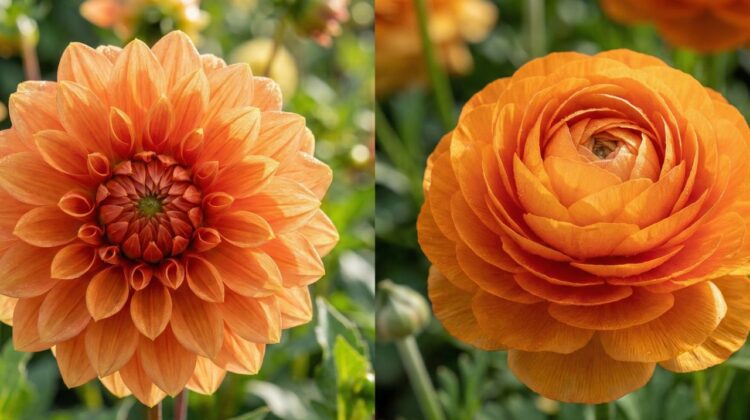
We all have that one friend who is incredibly beautiful, the life of the party, but also… a bit high-maintenance. In the garden, that friend is the Dahlia.
With their intricate, geometric petals and mesmerizing colors, Dahlias are masterpieces of nature. But let’s be honest: they can be divas. They need staking, they hate frost, and in cold climates, you have to dig up their ugly tubers every autumn and store them like precious artifacts.
As Shiny Aura, I often get asked: “Is there a flower that gives me the Dahlia look without the Dahlia drama?”
The answer is yes! Nature loves to repeat good designs. Whether you want a spring bloomer (since Dahlias are late-summer stars) or just an easier plant to grow, here are 10 flowers that look remarkably like Dahlias.
1. Ranunculus (The Spring Doppelgänger)
If Dahlias are the queens of late summer, Ranunculus are the queens of spring. They are the closest lookalike you will find. Just like Dahlias, they feature layers upon layers of paper-thin petals that spiral tightly inward.
The Difference: Ranunculus bloom much earlier, usually in cool spring weather. They grow from strange, claw-like corms rather than tubers. They are generally smaller and more delicate than the robust Dahlia, making them perfect for bridal bouquets.
2. Chrysanthemum (The Autumn Twin)
Specifically, the “Football Mum” or “Incurve Mum” varieties look nearly identical to large decorative Dahlias. Chrysanthemums take over the garden show exactly when Dahlias are starting to fade.
The Difference: Mums are generally hardier and tougher. They smell distinctively herbal/spicy, whereas Dahlias are scentless. If you want that geometric, pom-pom look in October and November, plant Mums.
3. Zinnia (The Low-Maintenance Cousin)
If you want the vibrant colors and shapes of a Dahlia but want to grow them from a 50-cent packet of seeds, choose Zinnias. Double-flowered varieties like the ‘Benary’s Giant’ or ‘California Giant’ produce massive heads that can easily fool the eye.
The Difference: Zinnias are annuals (they live for one season only). They are much easier to grow—just scatter the seeds in the dirt. They love heat even more than Dahlias do and don’t require the fuss of digging up tubers.
4. Camellia (The Winter Wonder)
The Camellia japonica is often called the “Winter Rose,” but structurally, it looks more like a formal Dahlia. With its perfect symmetry and waxy, overlapping petals, it offers that polished, geometric aesthetic.
The Difference: This is a woody shrub, not a herbaceous plant. It blooms in late winter or early spring. Unlike the herbaceous Dahlia which dies back to the ground, the Camellia provides glossy evergreen foliage all year round.
5. Peony (The Fluffy Lookalike)
While Peonies are generally looser and fluffier, certain “Double” or “Bomb” type Peonies can mimic the lush, fullness of a decorative Dahlia. They offer that same “dinner-plate” size impact in the garden.
The Difference: Peonies bloom in late spring/early summer. They are incredibly long-lived perennials (living 50+ years) that hate to be moved, whereas Dahlias are replanted often.
6. Double Tulip (The Peony-Dahlia Hybrid)
Standard tulips look like cups, but Double Late Tulips (often called Peony-flowering tulips) are packed with extra petals. Varieties like ‘Angelique’ or ‘Black Hero’ look strikingly like small waterlily-type Dahlias.
The Difference: They are spring bulbs. They provide that multi-petaled luxury at the start of the season, long before the first Dahlia shoot has even poked out of the soil.
7. African Marigold (The Spicy Pom-Pom)
We usually think of Marigolds as small border plants, but the giant African Marigold (Tagetes erecta) produces large, spherical blooms that look just like Pompon Dahlias.
The Difference: The scent! Marigolds have a pungent, musky scent (which repels pests), while Dahlias have no scent. They are strictly orange, yellow, or cream, whereas Dahlias come in every color except blue.
8. China Aster (Callistephus chinensis)
The China Aster is a florist favorite that mimics the spiky, needle-petaled “Cactus Dahlias.” The ‘Matsumoto’ or ‘Valkyrie’ series are particularly deceptive.
The Difference: These are annuals that bloom in late summer. They are excellent cutting flowers with strong stems, just like Dahlias, but are generally grown from seed each year.
9. Lisianthus (The Ruffled Romantic)
While often compared to a rose, double-flowered Lisianthus can also pass for a small, decorative Dahlia. They have a ruffled, layered appearance that looks very high-end.
The Difference: Lisianthus are notoriously difficult to grow from seed (they grow very slowly), so it’s best to buy seedlings. They have a remarkable vase life, often lasting two weeks or more.
10. Carnation (The Underrated Twin)
Don’t roll your eyes! A high-quality, large-headed Carnation has the same serrated petal edges and dense, ruffly structure as a decorative Dahlia. When grouped together tightly in a bouquet, the texture is almost indistinguishable.
The Difference: Carnations smell like cloves (spicy and sweet) and are much cheaper and hardier than Dahlias.
Final Thoughts
You don’t have to be faithful to just one flower. The best gardens have a rhythm.
- Spring: Plant Ranunculus and Double Tulips.
- Summer: Plant Zinnias and Carnations.
- Autumn: Plant Chrysanthemums (and yes, maybe one or two real Dahlias).
By mixing these “Dahlia Dupes” into your landscape, you get that lush, layered look from the first frost of spring to the last frost of winter.