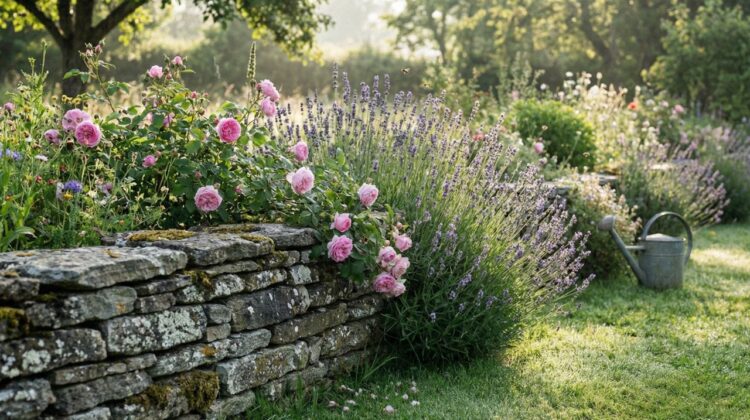
Plastic edging cracks. Wood edging rots. But Stone? Stone lasts forever.
There is a reason we still see stone walls standing from ancient civilizations. It is the most durable material on Earth. But beyond its longevity, stone brings an unmatched sense of grounding and history to a garden. It connects your cultivated flower beds back to the wild earth.
As Shiny Aura, I love using stone edging because no two rocks are identical. It guarantees that your garden border will be uniquely yours. Whether you want the clean lines of cut granite or the rustic charm of stacked slate, here are 10 stone edging ideas to define your landscape naturally.
In this article, we'll cover
1. The Dry-Stacked Flagstone Wall
This is the quintessential “English Cottage” look. It involves stacking flat, irregular slabs of stone (flagstone or slate) without using mortar.
The Aura: It looks like it has been there for a hundred years. You can plant creeping succulents like Sedum or Creeping Phlox in the crevices between the stones. Over time, moss will grow on the rough surfaces, adding to the fairytale charm.
2. Granite Cobblestone Setts
For a more formal, historic look, use granite cobblestones. These are roughly cube-shaped stones that were traditionally used to pave streets. Line them up in a single or double row.
Why it works: Granite often has a sparkle (mica) that catches the sunlight. It provides a crisp, sturdy edge that is heavy enough to stay in place without shifting, even in freeze-thaw cycles.
3. The River Rock Trench
Instead of building up, build down. Dig a shallow trench (about 4-6 inches wide) along the edge of your flower bed and fill it with smooth, round River Rocks.
Functionality: This acts as a “French Drain” of sorts, catching rainwater runoff. It also creates a textural buffer zone that prevents grass roots from creeping into your mulch. It’s casual, beachy, and very low maintenance.
4. Large Boulder Accents
Who says edging has to be a continuous line? Use large, basketball-sized (or larger) boulders spaced out along the edge of a garden bed. Fill the gaps between them with smaller stones or ground cover plants.
The Look: This mimics a natural mountain stream or a rockfall. It is perfect for sloping yards or xeriscaped gardens where you want to add visual weight and drama.
5. Cut Limestone Blocks
If your home is modern, you want straight lines and right angles. Cut limestone blocks offer a creamy, white/grey color and a smooth finish.
Shiny’s Tip: Use long, rectangular blocks to create a low retaining wall. The light color of limestone contrasts beautifully against dark soil and green foliage, making the garden look bright and clean.
6. Vertical Slate Chips
This is a trendy, textured look. Dig a trench and place thin shards of slate or shale vertically, packed tightly together side-by-side.
The Texture: It creates a ” jagged” edge that looks like a miniature mountain range. The dark grey or black color of slate is very sophisticated and hides dirt well.
7. The Pebble Mosaic Border
Turn your edging into art. Set smooth, uniform pebbles into wet mortar to create a decorative strip. You can create wave patterns, flowers, or geometric designs.
Best For: Framing a special feature, like a patio, a fountain, or a prized rose bush. It shows incredible attention to detail and craftsmanship.
8. Fieldstone “Necklace”
Using round, irregular fieldstones (stones found naturally in fields), create a single layer chain around your garden bed. This is the simplest DIY method—just place the stones on the ground.
The Vibe: It is informal and rustic. It works best for woodland gardens or country properties where a strict, straight line would look out of place.
9. Gabion Cages
For an industrial or ultra-modern look, use Gabion edging. These are small wire cages filled with crushed rocks or recycled concrete.
Why it works: It provides excellent drainage and acts as a heat sink (keeping soil warm). It has a very structural, architectural quality that pairs well with ornamental grasses.
10. Lava Rock Contrast
In tropical or desert gardens, use black or red lava rocks as your edging material. Because lava rock is lightweight and porous, it is easy to move around.
The Contrast: The porous texture holds moisture, and the dark color makes bright tropical flowers (like Hibiscus or Bird of Paradise) pop intensely.
Installation Pro Tip: The Trench is Key
The biggest mistake homeowners make is just setting stones on top of the grass. The grass will grow right over them in weeks.
Do this instead: Dig a “V” shaped trench (called spading) along the garden line. Remove the sod. Place your stones in the trench or on a bed of sand. This keeps the stones level and prevents them from sinking into the mud over time.
Final Thoughts
Stone is the bones of the landscape. While flowers fade and mulch decomposes, your stone edging will remain, providing structure and beauty through every season.